


Subsidiarity consistently thought through to the end
The text reflects the research and analysis results of the AI application „Perplexity“ and does not represent an expression of opinion by Gradido. It serves as information and as an impulse for further discussion.
Here is the report on the in-depth analysis of the ten Gradido community levels and national currency integration.
Key findings at a glance
Gradido's community level concept is an elegant mechanism for the Decentralized budget distributionThe second money creation (public budget) and the third money creation (equalization and environmental funds) are each 100 GDD per capita per month to each of the ten levels.
The ten levels follow the powers of ten 10^1 to 10^10 - from the family with ~10 people to the world population with ~10 billion. Each level has a range from half to five times the center value. The correspondence with real administrative structures in Germany is striking:
Level 5 (~100.000): County
Level 6 (~1 million): Large city like Cologne or small federal state like Bremen
Level 7 (~10 million): Large federal state (Bavaria, NRW) or small state
Level 8 (~100 million): Germany (83.5 million inhabitants, end of 2025)
Level 9 (~1 billion): EU or other continent
Level 10 (~10 billion): total humanity / UNO
The principle of subsidiarity is consistently implemented: Each level manages its budget completely autonomously, with no obligation to transfer funds upwards.
Overview and initial situation
The Gradido model is based on triple money creation: 3 × 1,000 GDD (Gradido) are created each month for every person on earth - 1,000 GDD each as an active basic income (1st pillar), 1,000 GDD for the public budget (2nd pillar) and 1,000 GDD for the Equalization and Environmental Fund - AUF for short (3rd pillar). This money creation is debt-free on a credit basis, in contrast to today's debt money system, in which every credit on one side necessarily generates an equal debt on the other side.
The second and third money creation - i.e. public budget and AUF - each provide 1,000 GDD per capita per month. The key structural innovation is that these two money flows are not managed via central government budgets, but are instead based on Ten community levels (community levels). Each level receives one tenth of the total amount - i.e. 100 GDD per capita per month from the public budget and other 100 GDD per capita per month from the AUF.
The ten community levels in detail
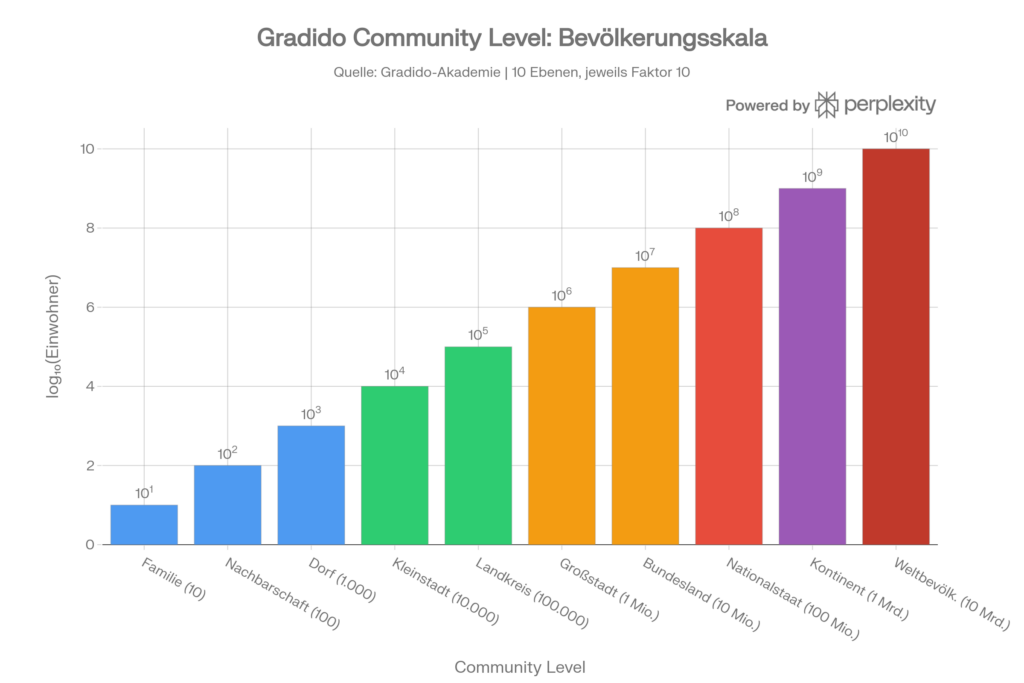
The concept of the ten community levels follows an elegant mathematical logic: the orders of magnitude strictly follow the powers of ten 10^1to 10^10. The limit of each plane starts at half the center value and ends at five times, so that the mean value serves as a reference value without being rigid.
n = number of inhabitants in the respective level. Note: The budget is always proportional to the local population.
It is striking that level 10^10 = 10 billion) corresponds very closely to the current world population. This is a remarkable „favorable coincidence“ - or an order of magnitude predetermined by nature that makes the system mathematically complete and consistent.
Subsidiarity as a core principle
The principle of Subsidiarity - which is anchored in German federalism as the principle that tasks should be transferred to higher levels as low-threshold as possible and only as far as necessary - finds its most consistent economic expression in the gradido community level system. Each community level manages its share completely autonomously. Higher levels do not receive any transfers from the budgets of the subordinate levels, as each level receives its budget directly from the creation of money.
The community level system goes beyond today's federalism: while Germany today differentiates between federal, state and local authorities, Gradido ten levels and thus consistently covers not only national, but also supranational and subnational levels - from the nuclear family to the human family.
Examples of the application of subsidiarity
A concrete example illustrates the principle of subsidiarity: Levels 1 and 2 (10 to 500 people) could provide healthcare at local level - of which the public budget for conventional healthcare and the AUF for alternative, natural healthcare. Level 3 (500-5,000, i.e. a village, a small town or a district parliament) manages basic municipal infrastructure. From level 4 (10,000 inhabitants), the units correspond to German small and medium-sized towns, and from level 5 (100,000) to large cities and districts.
Budget calculation using Germany as an example
By the end of 2025, Germany will have around 83.5 million inhabitants and thus falls within the range of Community Level 8 (10^8 = 100 million). The gradido model results in the following budget structure:
Total Gradido state budget for Germany
By way of comparison, Germany's total public budget in 2025 (federal, state, local and social security budgets combined) comprises expenditure of around 2,208 billion euros. The core budget of the federal government alone amounts to 502.5 billion euros
Elimination of large blocks of expenditure
By far the largest block of expenditure in the 2025 federal budget is the Federal Ministry of Labor and Social Affairs with 190.34 billion euros - more than a third of the total budget. In the Gradido system, this item is eliminated as unemployment and the need for social assistance are structurally overcome by the Active Basic Income (1st pillar, 1,000 GDD/capita/month). Tax and social security bureaucracy are also eliminated, which could mean cost savings of up to an estimated 146 billion euros in annual bureaucratic costs in Germany alone. A further 1,000 billion GDD is available for the Active Basic Income, which will be used to reward many public welfare activities that currently have to be financed from other sources. This should relieve the public budget by a further 3-digit billion euro amount.
Consistency with current administrative structures
A key advantage of the ten community levels is their Compatibility with existing administrative structures in Germany and comparable nation states:
This conformity enables a Gradual and smooth introduction, as no new administrative structure needs to be created. Existing municipalities, districts, federal states and the federal government would fit into the community levels and draw their budgets successively from the Gradido money creation. Of course, it must be defined in each individual case who belongs to which community level - but this allocation is essentially already predetermined by today's administrative boundaries.
Two separate cash flows per level: state budget and AUF
One conceptually significant detail is the Separation of state budget and AUF at every level. Both flow simultaneously, but are available for different purposes:
Public budget (2. Money creation): Conventional public services of general interest - infrastructure, education, conventional healthcare, administration, security.
Equalization and environmental funds (3. Money creation): Ecological restoration, environmental protection, natural health care and prevention, compensation for economic legacies, natural disaster relief.
This two-fund principle at each level makes it possible, for example at municipal level (L3-L4), for municipalities to finance both their mandatory tasks (SH) and voluntary environmental and health projects (AUF) - without competing for scarce funds, as both pots flow separately.
National introduction and the transition phase
As part of a national introduction (Vision 2032 for Germany), the existing national currency (euro) will be retained in full and will initially be used in parallel with Gradido. The introduction parity is 1 Euro = 1 GDD. As Gradido becomes more widespread, it takes on the function of a medium of exchange, while the euro or gold can retain their role as a store of value - a functional specialization that is also suitable for libertarian economists.
Gradido is designed in such a way that each country can start independently, to gradually introduce Gradido as a complementary currency. Other countries would follow until finally all countries worldwide use a consistent, mutually compatible system. As per capita money creation is always the same - regardless of national economic strength - there is no competitive disadvantage and no transfer pressure between countries. Every national community level structure is economically self-supporting.
Systemic balance: transience and stability
An essential feature of the Gradido system is the planned transience of 50% per year (approx. 5.61 % per month). This perishability prevents money from accumulating, accelerates circulation and thus replaces the function of interest. This has an important implication for the community-level budgets: unused funds are continually decreasing, which creates a strong incentive for prompt, sensible use and prevents accumulation.
At the same time, the constant creation of new money (per capita, monthly) ensures that the total amount of money remains stable - a self-regulating system modeled on the natural cycle of growth and decay.
Critical appraisal and open questions
Strengths of the model
Mathematical elegance: The power-of-ten logic creates a consistent structure that is valid for all orders of magnitude.
Compatibility with federalism: Extensive conformity with existing administrative structures facilitates the transition.
True subsidiarity: Each level has sovereignty over its own budget - no obligation to pay upwards.
Double cash flow: Separation of public budget and AUF enables both mandatory tasks and ecological transformation projects.
Open questions and challenges
Allocation competition: In practice, citizens belong to all 10 community levels at the same time. Clear criteria are needed as to which level is responsible for which tasks and how conflicts are decided. It would be conceivable, for example, for every citizen to have a say in the use of funds.
Transition problem: The change from debt-based to credit-based money creation is one of the biggest institutional transformation processes in economic history. Existing debt must be handled with care.
Political will: Gradido requires a decision by referendum or political majority. As the system renders existing tax and social bureaucracy obsolete, resistance from established institutions is to be expected.
Valuation parity: The assumption that 1 GDD = 1 euro depends on public confidence and economic stability. Hyperinflation in the eurozone could accelerate the introduction - or destabilize it.
Conclusion
Gradido's community level concept combines mathematical elegance with deep institutional logic. The ten levels of 10^1 to 10^10 - from the family to the world population - cover all forms of social organization and reflect the real administrative structure of nations such as Germany with astonishing accuracy. Real subsidiarity is realized through the equal distribution of 10% of the public budget and 10% of the AUF to each level: Each community manages its share autonomously without having to make transfers upwards.
For Germany, this means an annual gradido budget of around 200 billion GDD (100 billion SH + 100 billion AUF) at federal level (Level 8), which compares well with the current federal budget, as the largest block of expenditure for labor and social affairs (2025: 190 billion euros in the federal budget alone) is eliminated in the gradido system and international obligations are borne by L9 and L10.
The combination of decentralized self-administration, debt-free money creation and planned transience creates the structural prerequisites for a sustainable economic order oriented towards the common good.
warmest regards
Yours

Margret Baier and Bernd Hückstädt
Gradido founder and developer