


Freegaia – The City Begins to Shine · Episode 1 · Part 2 of 23
There's a strip of tape over the camera on Bob's laptop. It's been there ever since he got the laptop.
It's half past twelve. Alice has gone to bed; Bob is sitting at the kitchen table, typing in the address that was on her cell phone. The login page. A line scrolls across the top of the input fields every few seconds: Help. Give. Thank. Then: Community-driven. Decentralized. Open source. He waits for her to come back, then clicks on it. Nothing happens. Words are just words.
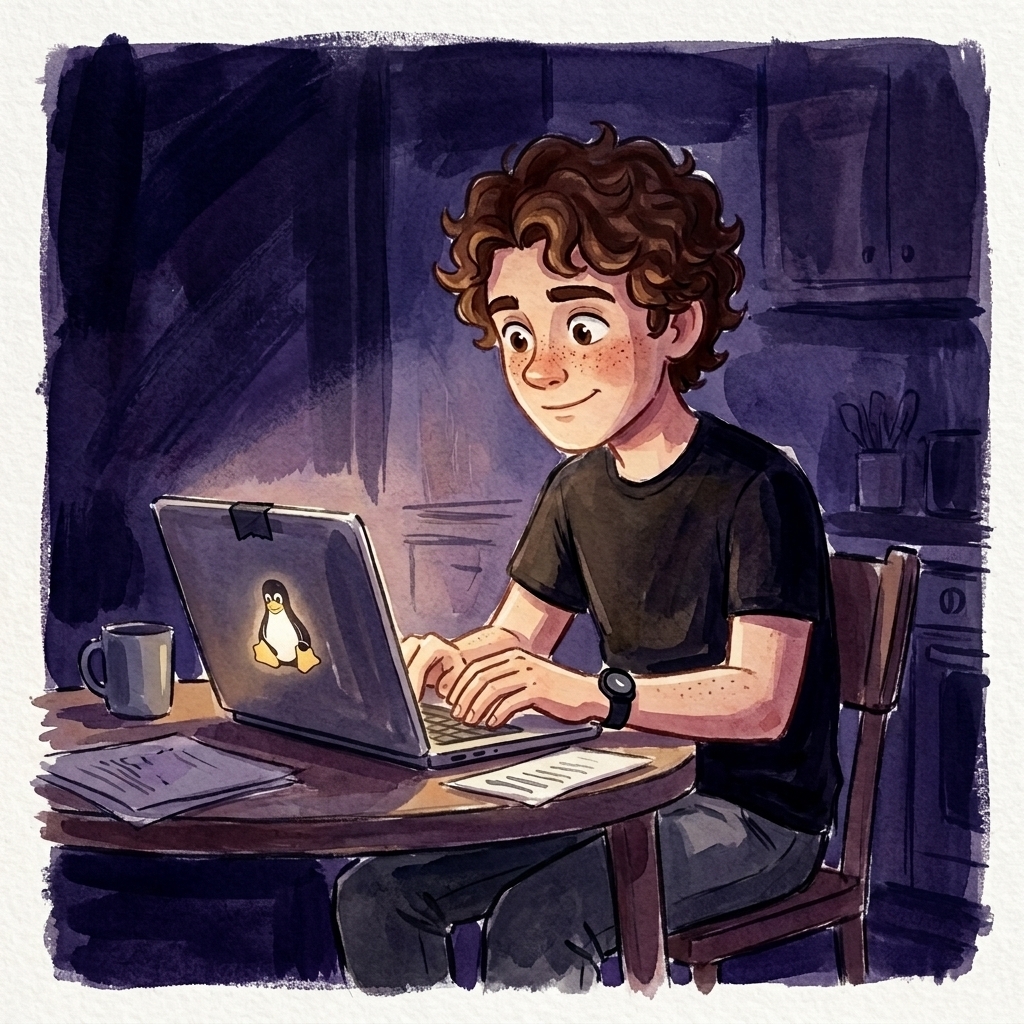
„If this is open source, you should be able to find it on GitHub,“ he mutters to himself. He goes to the site and types „Gradido“ into the search bar. And sure enough: there’s the entire source code! Every single line. The program that asks the question, the program that credits the hundred, the program that sends the email.
He reads until half past two. He’s looking for what he’s always looking for: the part where someone calls home. He doesn’t find it. He finds people arguing in the comments about whether a field Amount or Thanks is to be called.
In the morning, he's standing in the kitchen, and Alice doesn't ask.
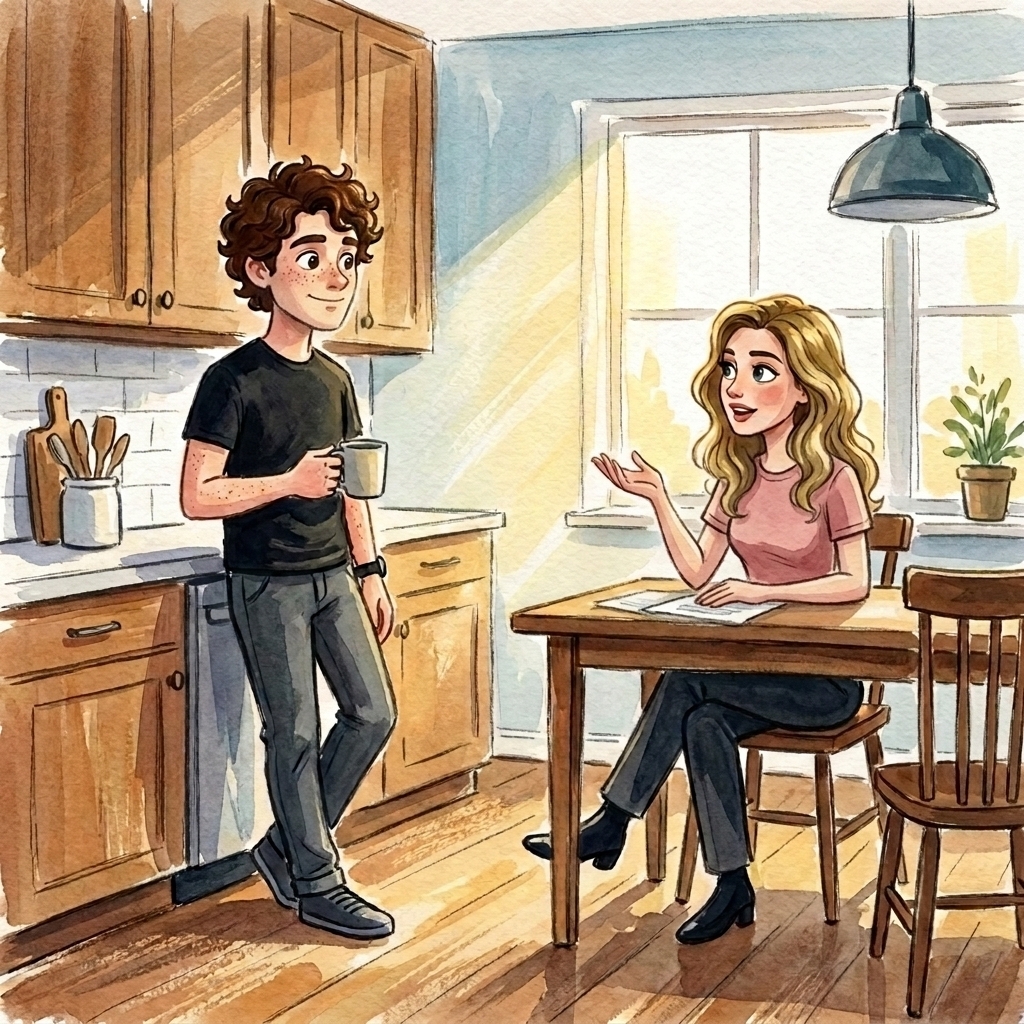
„I don't know yet if it's any good,“ he says. „But it's not a secret. Everything is out in the open on GitHub.“
„Carla is coming on Saturday.“
„I know.“
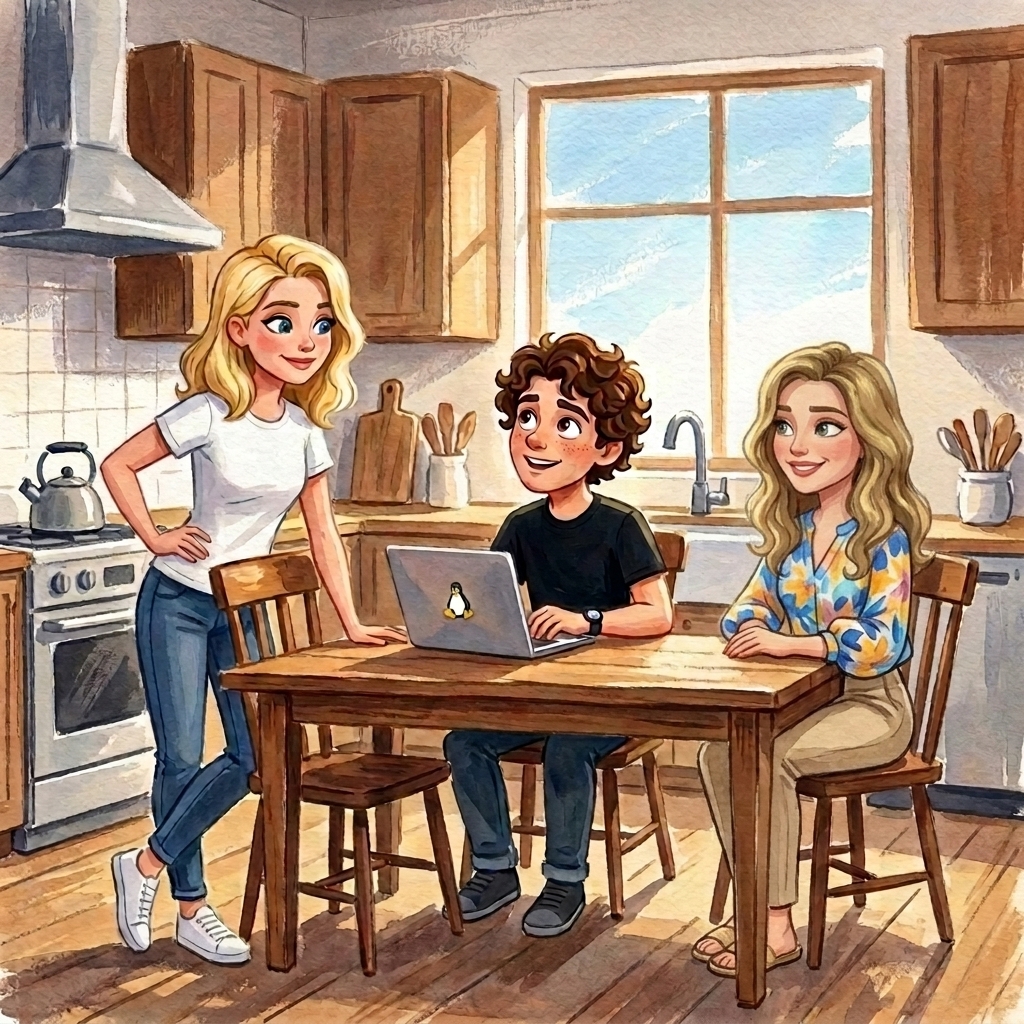
Carla arrives at three on Saturday with a cake from the bakery, and she hasn’t even taken off her jacket yet when she already knows how the afternoon is going to go. That’s Carla for you. She has a plan before the sentence is even finished. Gustav shows her his Legos, Helena shows her a drawing, and Carla says something nice about both, and then she sits down at the table and says, „Okay, let me see!“
Alice shows it. Not the question, not the hundred. She shows the card.
The city is on the cell phone, and there are little squiggles on the city. “Twenty-eight people found,” it says underneath. And on their street stands a little golden house.
„I’m the only one who sees it that way,“ says Alice. „The others see me somewhere in the vicinity, never at the front door. You can specify exactly or give a rough estimate. I went with a rough estimate.“
„Why not exactly?“ Carla asks.
„Because Bob was sitting next to him.“
Bob doesn't say anything. He looks at the twenty-eight curls. „They're just getting started,“ he says.
„Us too,“ says Carla. She already has her cell phone in her hand. „How does that work? I can’t receive emails on my cell phone. Only at home on my laptop.“
„I found something here.“ Bob takes Alice’s cell phone and opens the home screen. „It says ‚Show your friends‘ here.“ He taps it, and a QR code appears. „Scan the QR code. That’ll let you register for now. You can confirm your email address tonight when you get home.“
„Does that work? That’s brilliant!“ Carla is thrilled. „What’s it called?“
„You’re welcome,“ Alice laughs.
Carla's cell phone says: Alice will show you Gradido. While Helena explains to her what a horse and a dog are in her drawing, Carla types in her name, email address, and password.
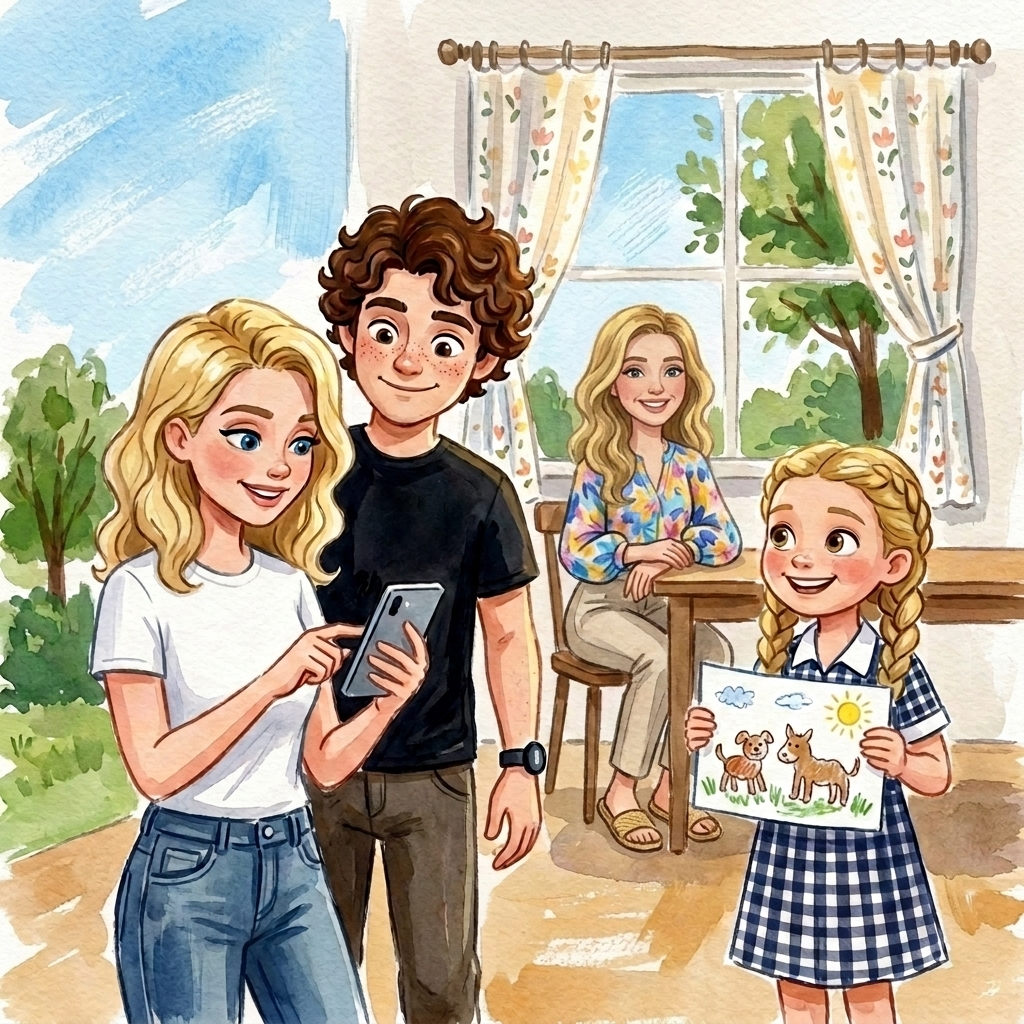
When she opens the account for the first time, it reminds her of the confirmation email, and Carla taps Later. Then it asks for a username so you can find them.
„Carla,“ Carla types.
„Carla's already gone,“ says Bob, looking over her shoulder.
„Carla-Sun.“
The name is blank. And then there's the question that Alice read at midnight.
Carla doesn't have to think twice. Last spring, she did the grocery shopping for Mrs. Meier from the third floor for six weeks, until her leg was healed. She worked the cash register at the street festival. She set up her neighbor's cell phone—twice. Three sentences, three gold checkmarks, and below them a three-letter code.
„One hundred,“ says Carla. „For Mrs. Meier.“
„You didn't want anything for Mrs. Meier,“ says Alice.
„I haven't gotten anything either.“ Carla looks at the number. „So far.“
Then she wants something, and Alice doesn't have to show her where: It's written under the number Thank someone now, and the recipient is already listed as Alice da. Amount: twenty. And in the field that Message She writes:
For showing.
Alice's cell phone lights up. Twenty Gradido, from Carla-Sonne, with two words.
„You're eighty now,“ Bob says to Carla, „and she's one hundred and twenty. And nobody paid for anything.“
„Is that the catch?“ Carla asks.
„That's what I still don't understand.“
He takes Alice's cell phone. There's a search bar above the map, and you can type something into it. Bob types Computer. Carla laughs because that would be the last thing she'd look for. And Alice laughs heartily along with her. On the map, a green star lights up among the squiggles, on the outskirts of the city. Bob taps it.
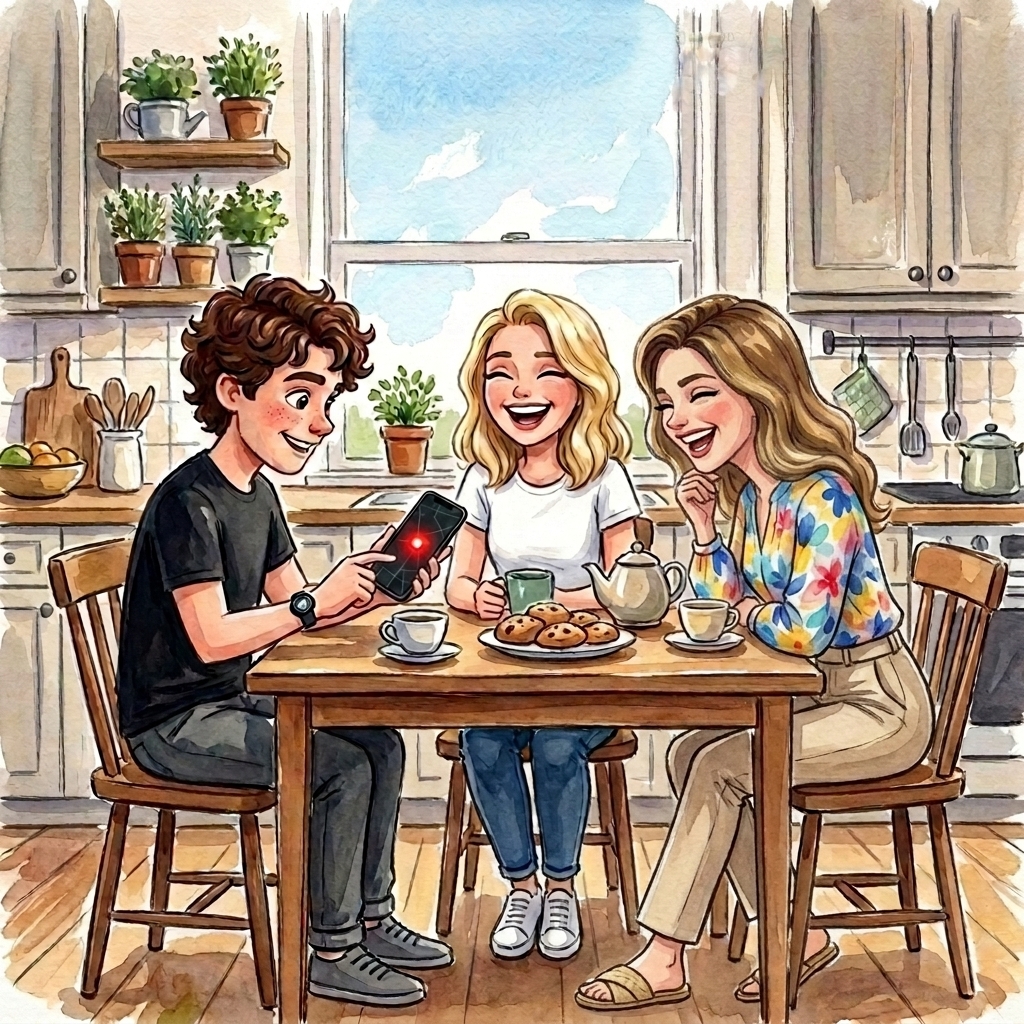
Fred. Runs websites. Is looking for someone to install Linux for him.
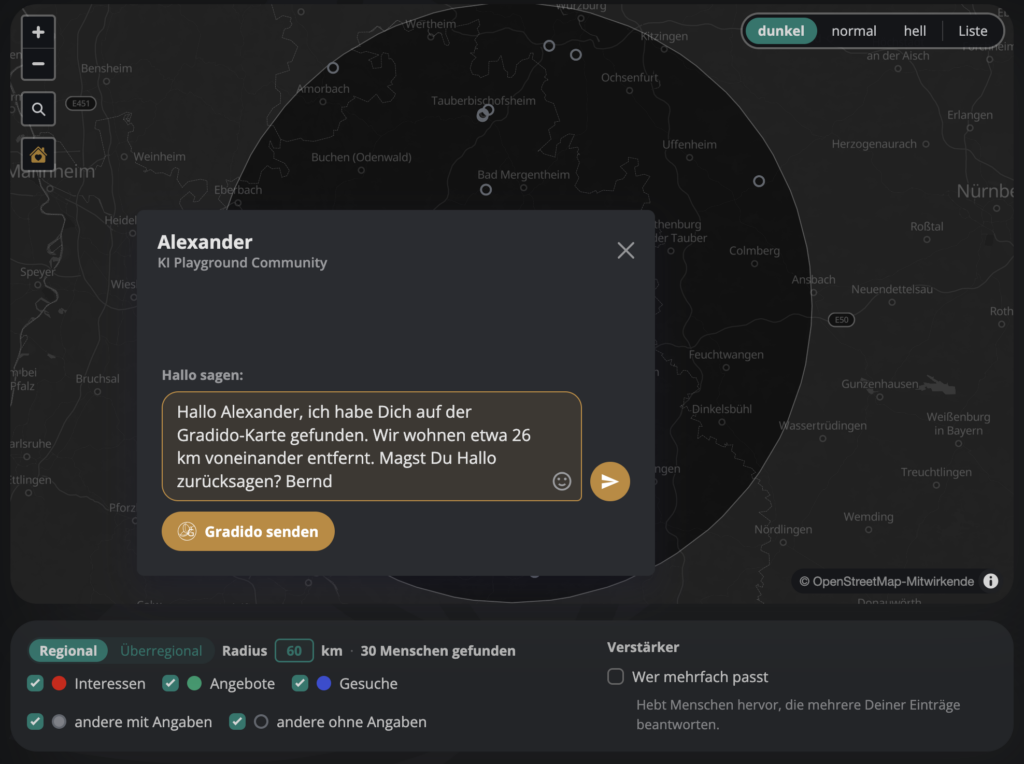
Bob reads it twice. He can install Linux in his sleep. Below that it says Saying hello:, and in a speech bubble there's already a sentence that nobody typed: Hi Fred, I found you on the Gradido map. We live about 6 km apart. Would you like to say hi back? Alice Next to it is an arrow. His thumb is already hovering over it as he reads the last word. The message is from Alice.
Bob leans back. „Now you’ve got me.“
He picks up his laptop—the one with the tape on the camera. Register. The email address, the password, the name: Bob is still available. Then comes the question of what good he has done in recent weeks. Bob reads the sentences—all of them—all the way to the bottom. Then he taps the button at the very bottom: I can't think of anything right now.
„You fixed my printer last week,“ says Alice.
„That was for you.“
„And Mrs. Meier was there for Carla.“
Bob doesn't answer. He's already closed the window. On the first page of his account, there's a question in a small box that reads: Who lives near you? He puts his home, approximately, and Alice doesn't say anything about it. Then he looks up Fred on the map, this time from his own account. The sentence in the speech bubble is there again, except that now at the end Bob is listed. So his identity is already there. He types two sentences about himself: what he can do and when he’s available. The community—not Bob—will forward the message to Fred via email; Fred won’t see Bob’s address, and Bob won’t see Fred’s. He read it last night, and he liked it.
When he taps the arrow, Carla, who has been watching the whole time, says, „I’m going to Emma’s on Sunday.“
„Who is Emma?“
„My neighbor. Seventy-five. She bakes.“ Carla stands up, and the plan is already set. „She can’t walk very well anymore and hardly ever leaves the house.“
Here's how it works in the software
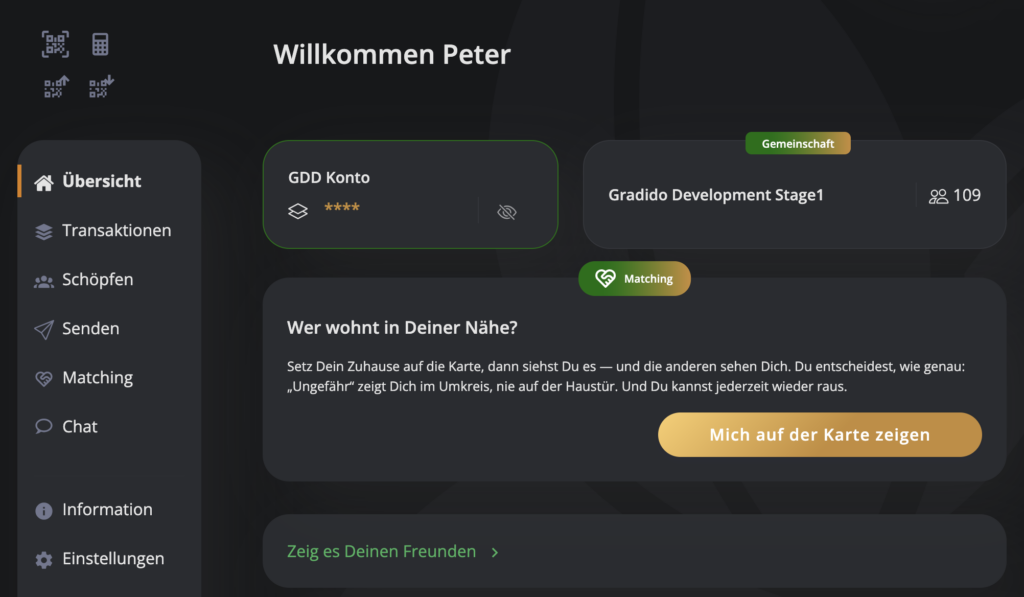
What Bob finds on Alice's cell phone on Saturday is also on the first page of your account: a small box that says „Show it to your friends.“.
- Show the code. Open your Gradido account and tap „Show it to your friends,“ then „Someone here with me.“ Your phone will display a code. It’s valid for ten minutes, and a new one is generated for each guest.
- Your guest scans it using the camera on their cell phone and reads: „[Your Name] is showing you Gradido.“ Tap „Create Account,“ enter your name, email, and password, and the account is set up. Your guest confirms the email later—just like Carla did that evening at home. Then the question from Episode 1 pops up, and among your first hundred Gradidos is „Thank someone now,“ with you as the recipient.
- Put your home on the map. The „Who lives near you?“ field on your first page or the „Matching“ menu will take you there: „Show me on the map,“ either exactly or approximately. “Approximately” shows your location within a radius—never right at your front door. From now on, you’ll be able to find each other on the map, and when you tap on someone there, you can say hello: The message is already in the speech bubble; the arrow sends it. The community forwards it via email, and your email addresses remain private.
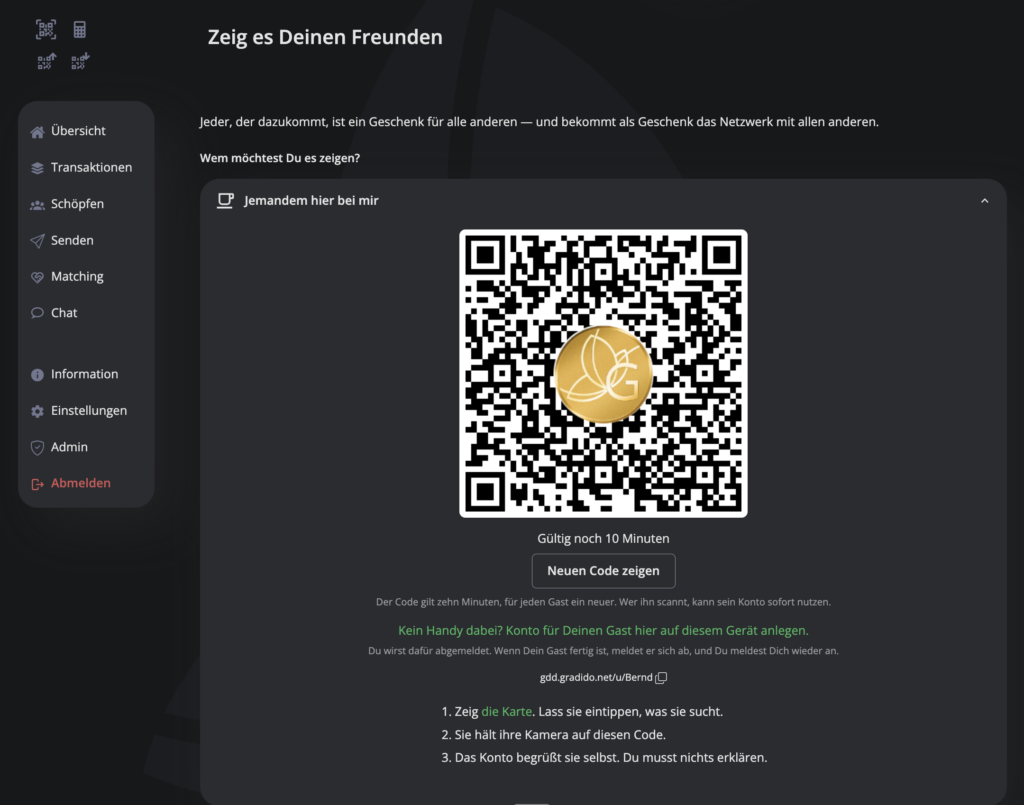
Your guest isn't sitting next to you? „Someone Else“ provides your Gradido address along with a short message for you to include in a message.
Is your home already on the map? If so, the next question will be, „Who’s a good match for you?“ and it’ll take you to your first entry. Episode 4 tells you all about it.
For anyone who, like Bob, wants to know exactly how it works: The entire source code is publicly available at GitHub, every line.
👉 Click here to access your Gradido account
Next episode on Thursday, October 29: „Freegaia 3 – Emma.“ Carla rings her neighbor’s doorbell, and there’s an iPad next to the cake.
All episodes on one page: Freegaia
warmest regards
Yours

Margret Baier and Bernd Hückstädt
Gradido founder and developer